
Criminal Cases in Ada County Courts
Ada County sits in Idaho's Fourth Judicial District. District judges hear felony cases, while the Magistrate Division handles misdemeanors, infractions, preliminary felony proceedings, and other assigned matters. City ordinance and misdemeanor matters from Boise, Meridian, and Eagle also move through this state court structure. None of those cities maintains a separate public municipal-court case database.
The Ada County Clerk keeps the official case file at the county courthouse. An arrest report may explain what an officer alleged, but the court file shows what a prosecutor actually filed and what the judge decided. Case numbers, dates, counts, and names help distinguish people with similar identities. The Ada County Judicial Court gateway provides current local court information and conduct rules.
The official court page gives useful context for Ada County criminal court cases.
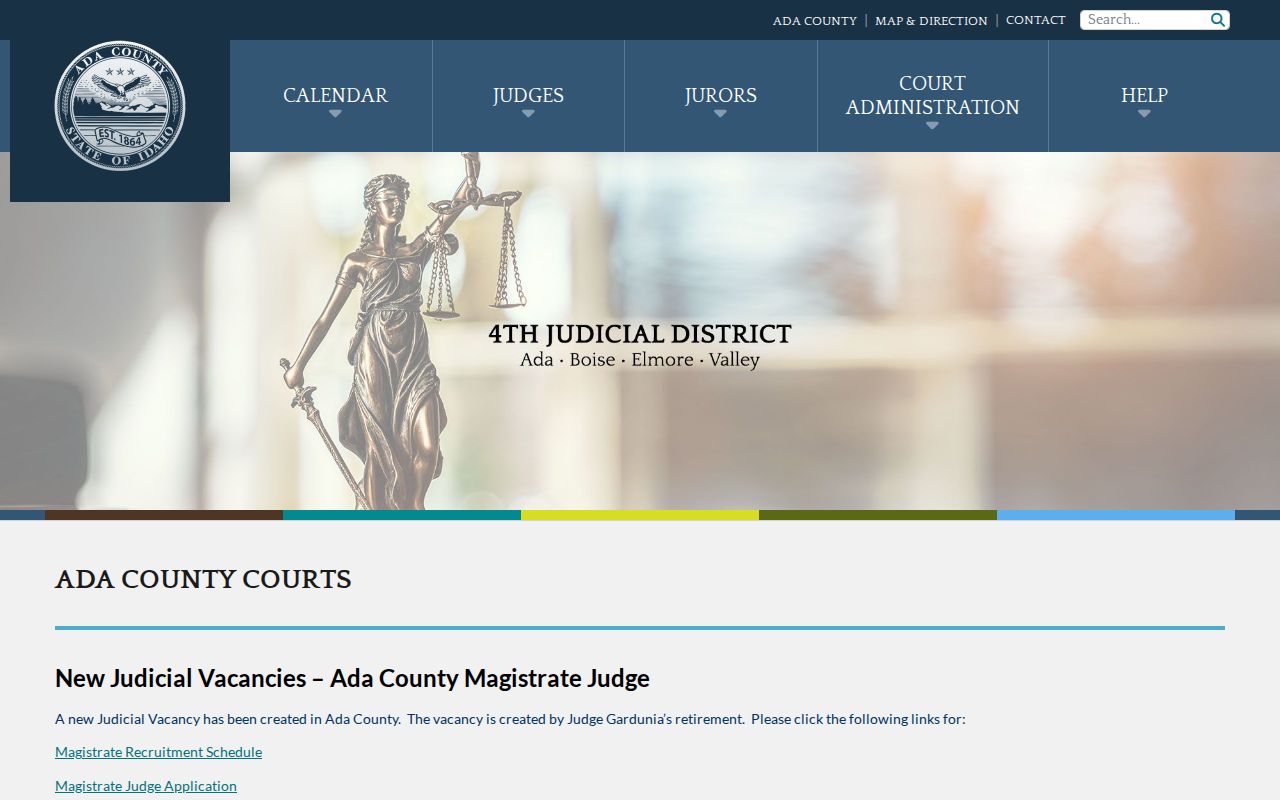
It also points users toward statewide iCourt and clerk access rather than a separate county docket engine.
Ada County Court Divisions
Idaho does not use a universal Class A, B, and C ladder for all crimes. A felony is an offense punishable by death or state-prison confinement, and exact punishment usually comes from the offense statute. Misdemeanors carry county-jail or fine exposure. Infractions do not bring jail under the governing rule. These labels matter because they identify the court path and the sort of Ada County case record likely to appear.
- District Court
- The felony-level trial court after required preliminary proceedings.
- Magistrate Division
- The division for misdemeanors, infractions, initial felony stages, and assigned local matters.
- Disposition
- The result entered for one charge, such as dismissal, acquittal, or conviction.
- Docket
- The dated list of filings, hearings, rulings, and other events in a case.
Note: Read the disposition for each count because one Ada County case may end with different results for different charges.
How to Search Case Records
The Idaho iCourt Portal is the first remote channel for Ada County criminal case records. Basic public case information is statewide. Some documents are not displayed, and sealed or restricted information will not appear. If the portal supplies metadata but no PDF, use a courthouse kiosk or ask the clerk where the case was filed.
- Open iCourt and choose the public case-search function.
- Search by case number when known, or enter a party name with careful spelling.
- Narrow the results by court, case type, or filing information to isolate the Ada County matter.
- Open the docket and compare the charge, hearing, disposition, and sentence entries count by count.
- Request an available copy or certified record from the Ada County Clerk when the online view is incomplete.
| Search field | Type | Required | Useful detail |
|---|---|---|---|
| Party name | Text | One search path | Try full and prior names |
| Case number | Text | Alternative | Best match when known |
| Court location | Filter | No | Narrow to Ada County |
| Case type | Filter | No | Separate criminal matters |
| Filing detail | Date/filter | No | Resolve similar results |
The official iCourt entry screen shows the current access route.
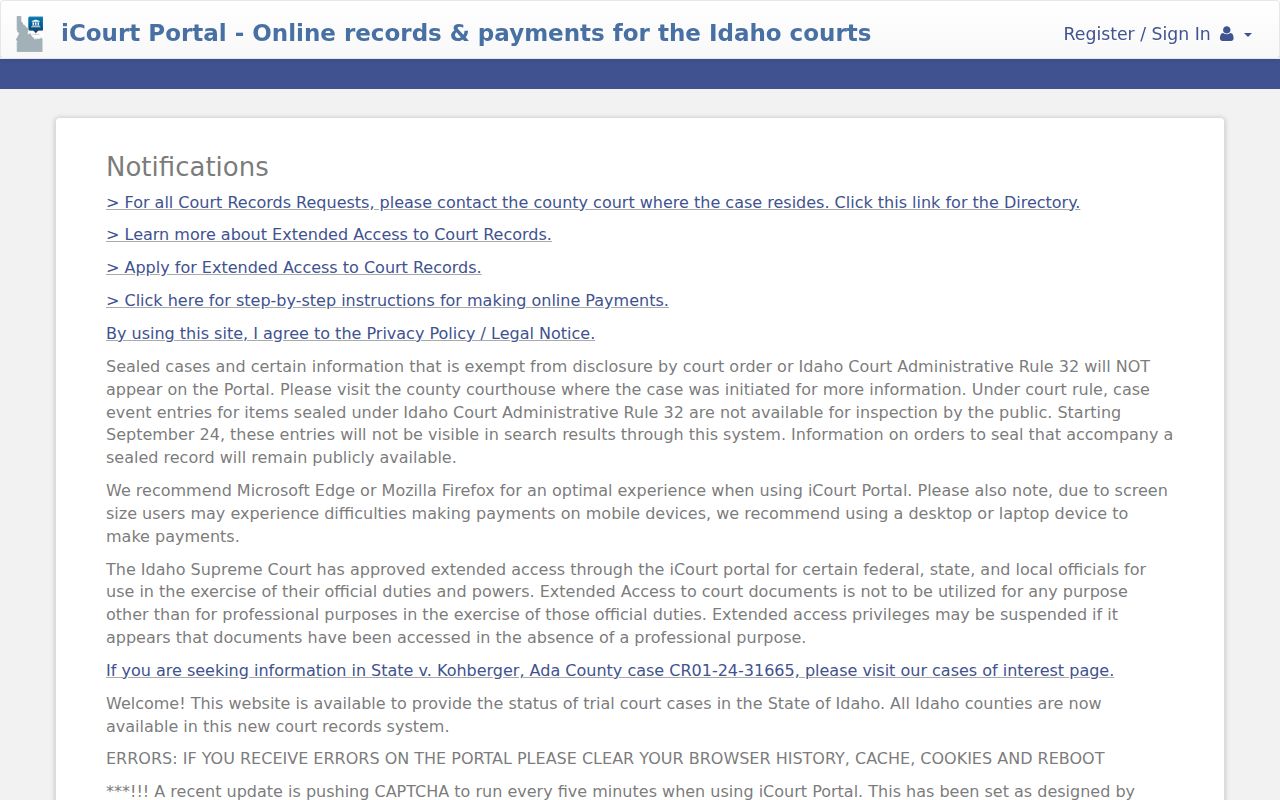
Search results are an index to the court record, not a substitute for every filed document.
Missing Ada County Court Documents
Idaho Courts explains the fallback chain on its court records access page: begin with iCourt, use a public courthouse kiosk, then request an individual case record from the clerk in the county where it was filed. This distinction is important in Ada County. A visible docket line may confirm that a motion or order exists even when the document image is not remotely available.
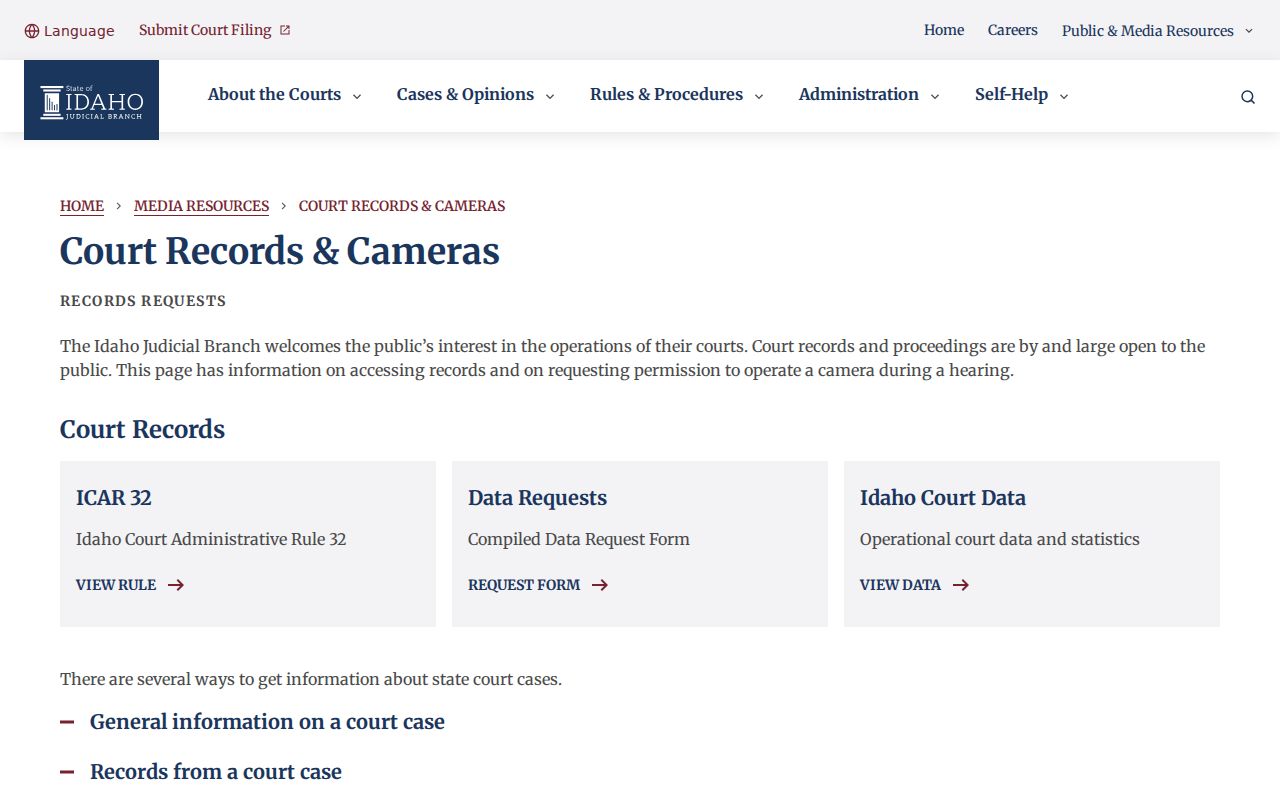
The screenshot reinforces that remote access and clerk access are two parts of the same official records path.
Ada County Courthouse
Fourth Judicial District and Clerk
200 W. Front St.
Boise, ID 83702-7300
(208) 287-6900
Bring the case number when possible. Ask whether the desired copy is public, available at a kiosk, or must be requested from the clerk. Recording or photographing a proceeding requires advance approval from the presiding judge, which is separate from obtaining a filed record.
What the Case File Shows
Ada County criminal case files can connect the filed accusation with the outcome. The charging document may be a complaint, information, or indictment. An information is a prosecutor's formal felony charging document after the required procedure; an indictment comes from a grand jury. Neither proves guilt. Later entries show pleas, motions, hearing dates, rulings, and the result of each count.
| Case Number & Court | Identifies the Ada County matter, division, and filing location. |
|---|---|
| Charging Document | Lists the offenses the state formally brought, which may differ from booking charges. |
| Docket Entries | Chronological index of filings, hearings, rulings, and notices. |
| Hearing Dates | Shows scheduled and completed proceedings, subject to later changes. |
| Disposition & Judgment | Records the outcome for each individual count. |
| Sentence & Conditions | States the court-ordered consequence and terms when a conviction occurs. |
The court record should be read beside, not replaced by, a booking entry. A prosecutor may decline a count, amend it, or file a different charge. The judgment and disposition are therefore the sound sources for the outcome.
Why Ada Booking Charges Change
Jail staff record the charge or warrant presented at booking. Prosecutors then assess reports and evidence before filing a court case. That gap explains why a recent arrest card can show one allegation while iCourt later shows an amended or narrower set of charges. It can also explain why no Ada County court case appears right after a booking.
The Ada County Prosecuting Attorney handles felony prosecution for Idaho and county-level matters, while appropriate city matters may be handled by city attorneys. The prosecutor is not the court-record custodian. Once filed, pleadings and outcomes belong in the clerk's case file.
This division of roles helps explain why a police report, prosecutor release, and iCourt docket can contain different levels of detail.
Stages of a Criminal Case
Ada County criminal proceedings do not move on one fixed schedule. Serious cases may involve preliminary hearings, motions, negotiations, or trial preparation. Lower-level cases can take a shorter path. The docket is the best public timeline because it records actual events and later changes.
Case flow: Charges Filed › Arraignment › Pretrial › Plea or Trial › Disposition › Sentencing
Arraignment is the hearing where the charge is stated and a plea is addressed. Pretrial events can include discovery disputes and motions. A plea resolves a case without trial, while a trial asks a judge or jury to decide the charge. Disposition is the result for a count. Sentencing follows a conviction, though later appeals or post-judgment orders can add more docket entries.
Ada Drug Court Docket Events
Ada County operates treatment-court programs, including Drug Court and Domestic Violence Court. Participation can produce hearings, status reviews, supervision terms, and later orders in the main criminal case. It does not create a separate public criminal-history database. Readers should follow the case number in iCourt and ask the clerk about public documents that are not shown online.
Ada County Treatment Services is located at 400 N. Benjamin Lane, Suite 200, Boise, and its main number is (208) 287-7660. That office may support program services, but the clerk remains the custodian for judicial records. Sensitive treatment information may be restricted even when a public docket reflects that an event occurred.
Note: A program status entry can describe procedure without making confidential treatment details open to the public.
Access and Restrictions
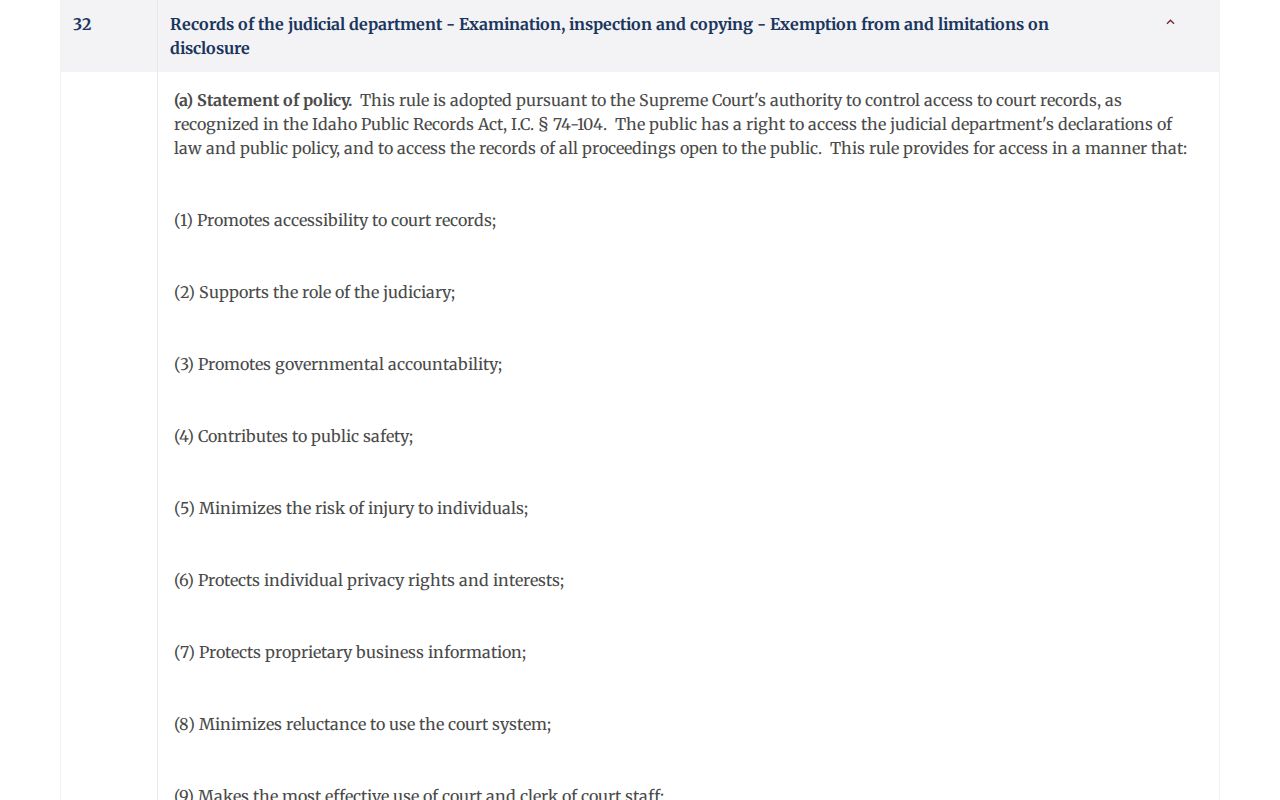
Judicial records are governed chiefly by Idaho Court Administrative Rule 32, not merely by an ordinary request under the Idaho Public Records Act. Rule 32 sets the court-specific access framework. Juvenile matters, protected victim details, sealed material, and other confidential information can be withheld or redacted. A missing result does not prove that no matter exists.
The official ICAR 32 source sets the boundary for Ada County criminal court access.
When a record cannot be found, give the clerk the name, case number, filing range, and court division, then ask whether the file is restricted, archived, or available only through a kiosk.
Beyond Ada County Trial Courts
An appeal leaves the trial-court path and enters Idaho's appellate system. The Ada County docket can show that an appeal was initiated, while the appellate file holds the later briefs and decisions. Follow the case number and any linked appellate identifier rather than assuming the county docket contains the complete higher-court record.
Federal criminal cases filed in Boise are different again. They belong to the U.S. District Court for the District of Idaho and are searched through PACER, not Idaho iCourt. The District of Idaho supplies courthouse and clerk information. This boundary prevents a common error: a blank state search does not rule out a federal case.